
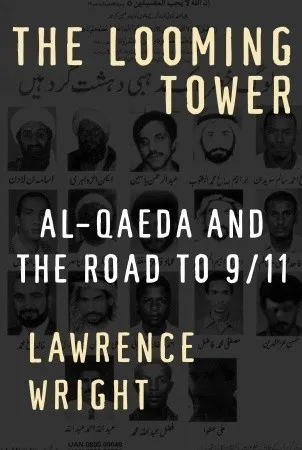
The Looming Tower
Page: 8, Location: 104
Note: CH.
This is the man, then—decent, proud, tormented, self-righteous—whose lonely genius would unsettle Islam, threaten regimes across the Muslim world, and beckon to a generation of rootless young Arabs who were looking for meaning and purpose in their lives and would find it in jihad.
Page: 12, Location: 164-166
Note: Sayd Qutb 1948
WHEN ZAWAHIRI RETURNED to his medical practice in Maadi, the Islamic world was still trembling from the political earthquakes of 1979, which included not only the Soviet invasion of Afghanistan but also the return of Ayatollah Ruhollah Khomeini to Iran and the toppling of the Peacock Throne—the first successful Islamist takeover of a major country.
Page: 56, Location: 870-873
Note: 1979 invasion of Afghanistan by Soviet , Irani revolution
IN THE MONTH between the surrender of the rebels and their mass execution, there was a new shock to the Islamic world: on Christmas Eve 1979 Soviet troops entered Afghanistan. “I was enraged and went there at once,” bin Laden later claimed. “I arrived within days, before the end of 1979.”
Page: 112, Location: 1762-1764
Note: 1979 Soviet invasion of Afghanistan
One fateful day in Peshawar, August 11, 1988, Sheikh Abdullah Azzam called a meeting to discuss the future of jihad. Bin Laden, Abu Hafs, Abu Ubaydah, Abu Hajer, Dr. Fadl, and Wa’el Julaidan were present. These men were bound by uncommon experiences but profoundly divided by their goals and philosophies.
Page: 155, Location: 2440-2442
Note: Official Birth of al-Qaeda
1 The Martyr
Page: 8, Location: 103-104
America itself had just been shaken by a lengthy scholarly report titled Sexual Behavior in the Human Male, by Alfred Kinsey and his colleagues at the University of Indiana. Their eight-hundred-page treatise, filled with startling statistics and droll commentary, shattered the country’s leftover Victorian prudishness like a brick through a stained-glass window.
Page: 14, Location: 202-205
“Either Communism must die, or Christianity must die, because it is actually a battle between Christ and the anti-Christ,” Billy Graham would write a few years later—a sentiment that was very much a part of the mainstream Christian American consensus at the time.
Page: 16, Location: 231-232
Christianity would be powerless to block this trend because it exists only in the realm of the spirit—“like a vision in a pure ideal world.” Islam, on the other hand, is “a complete system” with laws, social codes, economic rules, and its own method of government. Only Islam offered a formula for creating a just and godly society.
Page: 16, Location: 239-242
Thus the real struggle would eventually show itself: It was not a battle between capitalism and communism; it was between Islam and materialism. And inevitably Islam would prevail.
Page: 17, Location: 242-243
Banna was precocious and charismatic, but he was also a man of action. He founded the Muslim Brothers in 1928, with the goal of turning Egypt into an Islamic state.
Page: 19, Location: 277-279
The frantic pace of life that Qutb objected to in New York was far away. There was a front-page article in the Greeley Tribune that summer chronicling a turtle’s successful crossing of a downtown street.
Page: 21, Location: 318-319
Qutb would later write that “racism had brought America down from the summit to the foot of the mountain—taking the rest of humanity down with
Page: 23, Location: 344-345
Qutb would later write that “racism had brought America down from the summit to the foot of the mountain—taking the rest of humanity down with it.”
Page: 23, Location: 344-345
“Jazz is the American music, created by Negroes to satisfy their primitive instincts—their love of noise and their appetite for sexual arousal,” Qutb wrote, showing he was not immune to racial pronouncements.
Page: 26, Location: 397-399
the fact remained that materialism was the real American god. “The soul has no value to Americans,”
Page: 27, Location: 415-415
For the first time in twenty-five hundred years, Egypt was ruled by Egyptians.
Page: 31, Location: 475-476
In a story that would be repeated again and again in the Middle East, the contest quickly narrowed to a choice between a military society and a religious one. Nasser had the army and the Brothers had the mosques.
Page: 32, Location: 490-492
2 The Sporting Club
Page: 38, Location: 580-581
After the war Cairo became a sanctuary for Nazis, who advised the military and the government. The rise of the Islamist movement coincided with the decline of fascism, but they overlapped in Egypt, and the germ passed into a new carrier.
Page: 46, Location: 708-710
favored their cause. They had lost not only their armies and their territories but also faith in their leaders, in their countries, and in themselves.
Page: 45, Location: 700-701
It was a psychological turning point in the history of the modern Middle East. The speed and decisiveness of the Israeli victory in the Six Day War humiliated many Muslims who had believed until then that God favored their cause. They had lost not only their armies and their territories but also faith in their leaders, in their countries, and in themselves. The profound appeal of Islamic fundamentalism in Egypt and elsewhere was born in this shocking debacle.
Page: 45, Location: 699-702
“I realized they were introducing the Salafist formula, which does not recognize any Islamic traditions after the time of the Prophet,” Schleifer recalled. “It killed the poetry. It was chaotic.”
Page: 50, Location: 774-775
3 The Founder
Page: 71, Location: 1104-1104
Mohammed bin Awahd bin Laden was a legend even before Osama was born. He presented a formidable model to a young man who idolized him and hoped to equal, if not surpass, his achievements. Mohammed had been born in a remote valley in central Yemen.
Page: 73, Location: 1138-1140
Most Saudis reject the name Wahhabi; they either call themselves muwahhidun—unitarians—since the essence of their belief is the oneness of God, or Salafists, which refers to their predecessors (salaf), the venerated companions of the Prophet. The founder of the movement, Mohammed ibn Abdul Wahhab, was an eighteenth-century revivalist who believed that Muslims had drifted away from the true religion as it had been expressed during the Golden Age of the Prophet and his immediate successors. Among other theological innovations, Abdul Wahhab believed that God clothed Himself in a human form; he rejected the intercessory prayer of saints and expressions of reverence for the dead; and he demanded that Muslim men refuse to trim their beards. He
Page: 74, Location: 1159-1164
The essence of their understanding was that there was no difference between religion and government. Abdul Wahhab’s extreme views would always be a part of the fabric of Saudi rule.
Page: 75, Location: 1170-1171
Twitchell’s discovery opened the way for the partnership that eventually came to be known as the Arabian American Oil Company—Aramco. Over the next few years, a small colony of petroleum engineers and roughnecks set up an oil camp in the Eastern Province.
Page: 76, Location: 1181-1183
Change
Page: 100, Location: 1561-1561
The essential experience of living on the Arabian Peninsula was that nothing changed. The
Page: 102, Location: 1598-1598
The essential experience of living on the Arabian Peninsula was that nothing changed. The eternal and the present were one and the same.
Page: 102, Location: 1598-1599
Here in this primitive land, so stunted by poverty and illiteracy and patriarchal tribal codes, the heroic and seemingly doomed Afghan jihad against the Soviet colossus had the elements of an epochal moment in history. In the skillful hands of Sheikh Abdullah Azzam, the legend of the Afghan holy warriors would be packaged and sold all over the world.
Page: 114, Location: 1794-1796
The people who rallied to the Afghan jihad felt that Islam itself was threatened by the advance of communism. Afghanistan meant little to most of them, but the faith of the Afghan people meant a great deal. They were drawing a line against the retreat of their religion, which was God’s last word and the only hope of human salvation.
Page: 116, Location: 1817-1819
Miracles
Page: 117, Location: 1833-1834
Zbigniew Brzezinski, who was the U.S. national security
Page: 118, Location: 1843-1844
Zbigniew Brzezinski, who was the U.S. national security advisor for the Carter administration. Brzezinski, however, saw the invasion as an opportunity. He wrote to Carter immediately, saying, “Now we can give the USSR its own Vietnam war.” Looking for an ally in this endeavor, the Americans naturally turned to the Saudis—that is, to Turki, the American-educated prince who held the Afghan account.
Page: 118, Location: 1843-1846
These seven mujahideen leaders came to be known, by the CIA and other intelligence agencies that were their principal means of support, as the Seven Dwarves.
Page: 119, Location: 1859-1860
Radicalism usually prospers in the gap between rising expectations and declining opportunities. This is especially true where the population is young, idle, and bored; where the art is impoverished; where entertainment—movies, theater, music—is policed or absent altogether; and where young men are set apart from the consoling and socializing presence of women. Adult illiteracy remained the norm in many Arab countries. Unemployment was among the highest in the developing world. Anger, resentment, and humiliation spurred young Arabs to search for dramatic remedies.
Page: 127, Location: 1985-1989
Martyrdom promised such young men an ideal alternative to a life that was so sparing in its rewards. A glorious death beckoned to the sinner, who would be forgiven, it is said, with the first spurt of blood, and he would behold his place in Paradise even before his death. Seventy members of his household might be spared the fires of hell because of his sacrifice. The martyr who is poor will be crowned in heaven with a jewel more valuable than the earth itself. And for those young men who came from cultures where women are shuttered away and rendered unattainable for someone without prospects, martyrdom offered the conjugal pleasures of seventy-two virgins—“the dark-eyed houris,” as the Quran describes them, “chaste as hidden pearls.” They awaited the martyr with feasts of meat and fruit and cups of the purest wine.
Page: 127, Location: 1989-1995
For the journalists covering the war, the Arab Afghans were a curious sideshow to the real fighting, set apart by their obsession with dying. When a fighter fell, his comrades would congratulate him and weep because they were not also slain in battle. These scenes struck other Muslims as bizarre. The Afghans were fighting for their country, not for Paradise or an idealized Islamic community. For them, martyrdom was not such a high priority.
Page: 127, Location: 1996-1999
“He who dies and has not fought and was not resolved to fight, has died a jahiliyya death,” Hasan al-Banna, the founder of the Muslim Brothers, had declared. He added, with a bit of residual Sufi mysticism, “Death is art.”
Page: 128, Location: 2014-2016
Al-Qaeda was conceived in the marriage of these assumptions: Faith is stronger than weapons or nations, and the ticket to enter the sacred zone where such miracles occur is the willingness to die.
Page: 143, Location: 2242-2243
The Base
Page: 143, Location: 2245-2245
Takfir is the mirror image of Islam, reversing its fundamental principles but maintaining the semblance of orthodoxy. The Quran explicitly states that Muslims shall not kill anyone, except as punishment for murder. The murderer of one innocent, the Quran warns, is judged “as if he had murdered all of mankind.” The killing of Muslims is an even greater offense. He who commits such an act, says the Quran, will find that “his repayment is Hell, remaining in it timelessly, forever.” How, then, could groups such as al-Jihad and the Islamic Group justify using violence against fellow Muslims in order to come to power?
Page: 147, Location: 2306-2310
There is a well-known saying of the Prophet that the blood of Muslims cannot be shed except in three instances: as punishment for murder, or for marital infidelity, or for turning away from Islam. The pious Anwar Sadat was the first modern victim of the reverse logic of takfir.
Page: 147, Location: 2311-2313
The dynamic of the two men’s relationship made Zawahiri and bin Laden into people they would never have been individually; moreover, the organization they would create, al-Qaeda, would be a vector of these two forces, one Egyptian and one Saudi. Each would have to compromise in order to accommodate the goals of the other; as a result, al-Qaeda would take a unique path, that of global jihad.
Page: 151, Location: 2368-2370
From the beginning, al-Qaeda presented itself as an attractive employment opportunity for men whose education and careers
Page: 168, Location: 2647-2648
New recruits filled out forms in triplicate, signed their oath of loyalty to bin Laden, and swore themselves to secrecy. In return, single members earned about 1,000amonthinsalary;marriedmembersreceived1,500. Everyone got a round-trip ticket home each year and a month of vacation. There was a health-care plan and—for those who changed their mind—a buyout option: They received $2,400 and went on their way. From the beginning, al-Qaeda presented itself as an attractive employment opportunity for men whose education and careers had been curtailed by jihad.
Page: 168, Location: 2643-2648
Return of the Hero
Page: 171, Location: 2687-2687
So when bin Laden returned to his hometown of Jeddah in the fall of 1989, he presented a dilemma that was unique in modern Saudi history. Only thirty-one years old, he commanded an international volunteer army of unknown dimensions. Because he actually believed the fable, promoted by the Saudi press, that his Arab legion had brought down the mighty superpower, he arrived with certain unprecedented expectations of his future. He was better known than all but a few princes and the upper tier of Wahhabi clergy—the Kingdom’s first real celebrity.
Page: 171, Location: 2690-2694
The lesson the family drew from that gory standoff was that it could protect itself against religious extremists only by empowering them.
Page: 173, Location: 2718-2719
Officially known as representatives of the Committee for the Promotion of Virtue and the Prevention of Vice, the muttawa would become the models for the Taliban in Afghanistan.
Page: 173, Location: 2724-2725
Few countries in the world were so different from each other, and yet so dependent on one another, as America and Saudi Arabia.
Page: 179, Location: 2821-2822
The American mission quickly grew from protecting Saudi Arabia to repelling the Iraqis from Kuwait. The war began on January 16,1991.
Page: 189, Location: 2976-2977
“We can see a new world coming into view,” Bush told Congress, “in which there is the very real prospect of a new world order…. A world where the United Nations, freed from cold war stalemate, is poised to fulfill the historic vision of its founders. A world in which freedom and respect for human rights find a home among all nations.” These words, uttered so hopefully, found a bitter audience in Osama bin Laden. He also wanted to create a new world order, one that was ruled by Muslims, not dictated by America and enforced by the UN. The scale of his ambition was beginning to reveal itself. In his fantasy he would enter history as the savior of Islam.
Page: 189, Location: 2986-2991
Paradise
Page: 191, Location: 3013-3013
Some countries simply refused to let the fighters return. They became a stateless, vagrant mob of religious mercenaries. Many of them took root in Pakistan, marrying local women and learning to speak Urdu. Some went to fight in Kashmir, Kosovo, Bosnia, or Chechnya. The cinders of the Afghan conflagration were drifting across the globe, and soon much of the Muslim world would be aflame.
Page: 192, Location: 3023-3025
In June 1989, at the same time that the jihad was ending in Afghanistan, Islamists staged a military coup d’état against the civilian, democratic government of Sudan. The leader of the coup was Brigadier General Omar Hasan al-Bashir, but the prime mover was Hasan al-Turabi, one of Africa’s most complex, original, charismatic, and devious characters.
Page: 192, Location: 3026-3029
Nonetheless, bin Laden made him head of al-Qaeda’s fatwa committee—a fateful choice. It was on Abu Hajer’s authority that al-Qaeda turned from being the anti-communist Islamic army that bin Laden originally envisioned into a terrorist organization bent on attacking the United States, the last remaining superpower and the force that bin Laden and Abu Hajer believed represented the greatest threat to Islam.
Page: 201, Location: 3165-3168
Why did these men turn against America, a highly religious country that so recently had been their ally in Afghanistan? In large part, it was because they saw America as the locus of Christian power.
Page: 201, Location: 3168-3169
They bitterly perceived the contradiction embodied by Islam’s long, steady retreat from the gates of Vienna, where on September 11—that now resonant date—in 1683, the king of Poland began the battle that turned back the farthest advance of Muslim armies. For the next three hundred years, Islam would be overshadowed by the growth of Western Christian societies. Yet bin Laden and his Arab Afghans believed that, in Afghanistan, they had turned the tide and that Islam was again on the march.
Page: 201, Location: 3174-3178
But by defining modernity, progress, trade, consumption, and even pleasure as Western assaults on Islam, al-Qaeda thinkers left little on the table for themselves.
Page: 202, Location: 3189-3190
A new vision of al-Qaeda was born. Abu Hajer’s two fatwas, the first authorizing the attacks on American troops and the second, the murder of innocents, turned al-Qaeda into a global terrorist organization. Al-Qaeda would concentrate not on fighting armies but on killing civilians.
Page: 205, Location: 3239-3241
The former conception of al-Qaeda as a mobile army of mujahideen that would defend Muslim lands wherever they were threatened was now cast aside in favor of a policy of permanent subversion of the West. The Soviet Union was dead and communism no longer menaced the margins of the Islamic world. America was the only power capable of blocking the restoration of the ancient Islamic caliphate, and it would have to be confronted and defeated.
Page: 205, Location: 3241-3244
The Silicon Valley
Page: 206, Location: 3245-3246
Paradise Lost
Page: 219, Location: 3447-3447
Finally, on March 5, 1994, Fahd personally decided to revoke bin Laden’s Saudi citizenship.
Page: 228, Location: 3597-3598
The Prince of Darkness
Page: 236, Location: 3730-3730
They were quite different men, but O’Neill and bin Laden were well-matched opponents: ambitious, imaginative, relentless, and each eager to destroy the other and all he represented.
Page: 244, Location: 3856-3857
“This battle is not between al-Qaeda and the U.S.,” bin Laden would later explain. “This is a battle of Muslims against the global Crusaders.” It was a theological war, in other words, and the redemption of humanity was at stake.
Page: 245, Location: 3863-3864
The Boy Spies
Page: 249, Location: 3928-3928
But the Saudis made it obvious to everyone that they were washing their hands of bin Laden. Bin Laden wasn’t yet a wanted man, but he certainly was an unwanted one.
Page: 259, Location: 4087-4088
Bin Laden left on May 18, 1996. His family was scattered and broken. The organization that he had built was torn apart. He held America responsible for the crushing reversal that had led him to this state.
Page: 261, Location: 4118-4119
Hijira
Page: 261, Location: 4120-4120
As bin Laden passed over Kabul, the capital was under siege once again, this time by the Taliban. They had arisen in 1994 as a small group of students, most of them orphans who had been raised in the refugee camps and who were outraged by the chaos and depravity of the rule of the mujahideen. The liberators in the war against the Soviets had turned out to be more barbaric rulers than their enemy. Stirred to action by the misery that victory had brought to Afghanistan, the Taliban arose with stunning swiftness. Thanks to the support of Pakistani intelligence, they were transformed from a populist militia into a formidable, highly mobile guerrilla army, on the verge of consolidating their rapid rise to power as they stood on the outskirts of Kabul, raining rockets into the ruins.
Page: 262, Location: 4135-4141
Thus bin Laden came under the control of a political hermit named Mullah Mohammed Omar, who had only recently declared himself “the ruler of all Muslims.”
Page: 263, Location: 4160-4161
The students (the word in Pashtu is “taliban”)
Page: 264, Location: 4174-4175
These two, the noseless bear and the blind lion, together with two wolves, were the only animals that survived the Taliban rule.
Page: 269, Location: 4255-4256
Prophet’s life when, in 622, ostracized and ridiculed, he was expelled from Mecca and fled to Medina. The hijira, or retreat, as the event is called, was such a significant turning point that it begins the Islamic calendar. The hijira transformed Mohammed and his demoralized followers. Within a few years, their nascent religion burst out of Medina and spread from Spain to China in a blinding flash of conversion and conquest.
Page: 271, Location: 4279-4282
August 23, 1996, in his “Declaration of War Against the Americans Occupying the Land of the Two Holy Places.” The latest indignity—“one of the worst catastrophes to befall the Muslims since the death of the Prophet”—was the presence of American and coalition troops in Saudi Arabia. The purpose of his treatise was “to talk, work, and discuss ways of rectifying what has befallen the Islamic world in general and The Land of the Two Holy Mosques in particular.”
Page: 273, Location: 4310-4314
Bin Laden was noncommittal, although he did formally ask Mohammed to join al-Qaeda and move his family to Afghanistan. Mohammed politely declined. But the seed of September 11 had been planted.
Page: 276, Location: 4353-4354
Going Operational
Page: 276, Location: 4355-4356
Bread and Water
Page: 285, Location: 4501-4501
Sheikh Omar Abdul Rahman added his imprimatur
Page: 298, Location: 4716-4716
“Now It Begins”
Page: 305, Location: 4820-4820
It was August 7, 1998, the same day the slaughter commenced in Mazar-e-Sharif and the anniversary of the arrival of American troops in Saudi Arabia eight years before.
Page: 315, Location: 4979-4981
But that, as it turned out, was exactly the point. Bin Laden wanted to lure the United States into Afghanistan, which was already being called the graveyard of empires. The usual object of terror is to draw one’s opponent into repressive blunders, and bin Laden caught America at a vulnerable and unfortunate moment in its history.
Page: 318, Location: 5025-5027
The main legacy of Operation Infinite Reach, however, was that it established bin Laden as a symbolic figure of resistance, not just in the Muslim world but wherever America, with the clamor of its narcissistic culture and the majestic presence of its military forces, had made itself unwelcome.
Page: 333, Location: 5283-5285
The New Millennium
Page: 334, Location: 5293-5293
Boom
Page: 350, Location: 5544-5544
The unspoken compact that the Germans made with the radical foreign elements inside their country was that if Germans themselves were not attacked, they would be left alone. In recoiling from its own extremist past, Germany inadvertently became the host of a new totalitarian movement.
Page: 355, Location: 5633-5635
AL-QAEDA HAD DEVELOPED a management philosophy that it called “centralization of decision and decentralization of execution.” Bin Laden decided on the targets, selected the leaders, and provided at least some of the funding. After that, the planning of the operation and the method of attack were left to the men who would have the responsibility of carrying it out.
Page: 370, Location: 5869-5872
The Big Wedding
Page: 388, Location: 6158-6158
Then he quoted a passage from the fourth sura of the Quran, which he repeated three times in the speech—an obvious signal to the hijackers who were on their way: Wherever you are, death will find you, even in the looming tower.
Page: 409, Location: 6494-6497
Revelations
Page: 422, Location: 6717-6717