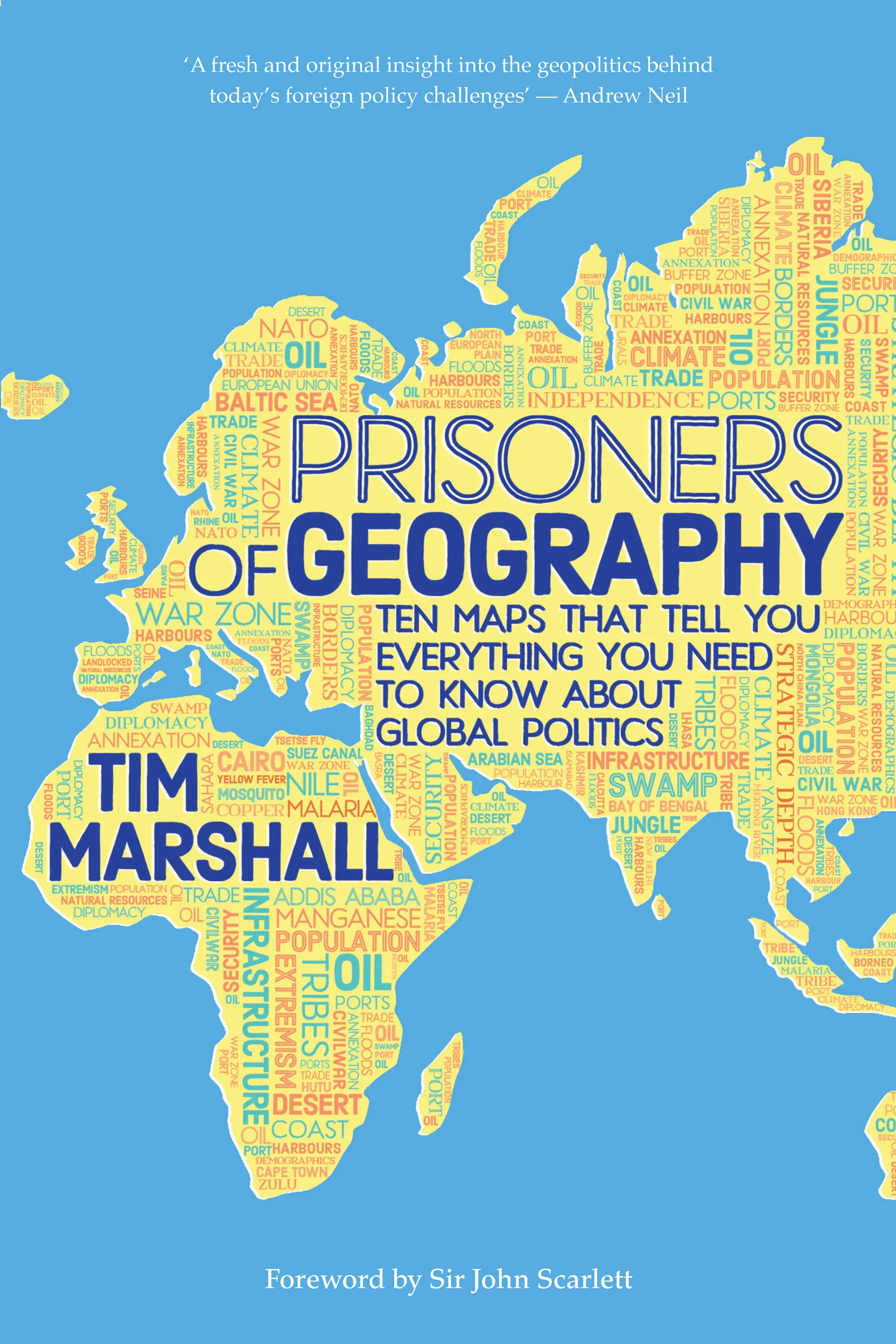
Prisoners of Geography
So it is with all nations, big or small. The landscape imprisons their leaders, giving them fewer choices and less room to manoeuvre than you might think. This was true of the Athenian Empire, the Persians, the Babylonians and before; it was true of every leader seeking high ground from which to protect their tribe.
Page: 5, Location: 68-70
If it can avoid a serious conflict with Japan or the United States, then the only real danger to China is itself. There are 1.4 billion reasons why China may succeed, and 1.4 billion reasons why it may not surpass America as the greatest power in the world. A great depression such as in the 1930s could set it back decades. China has locked itself into the global economy. If we don’t buy, they don’t make. And if they don’t make, there will be mass unemployment. If there is mass and long-term unemployment, in an age when the Chinese are a people packed into urban areas, the inevitable social unrest could be—like everything else in modern China—on a scale hitherto unseen.
Page: 62, Location: 943-948
Note: Summary : China is a country gifted natural barriers but its sea way is little weak, uts slowly building itself. from the great chinese empire to the prc. its the geography of the plains and river systems that lead to the feedng of populton. The chinese temperament of society over individual has big influence.
In 2012, he wrote an article for Germany’s best-selling daily newspaper, Bild, and was clearly still haunted by the possibility that, because of the financial crisis, the current generation of leaders would not nurture the postwar experiment in European trust: “For those who didn’t live through this themselves and who especially now in the crisis are asking what benefits Europe’s unity brings, the answer despite the unprecedented European period of peace lasting more than 65 years and despite the problems and difficulties we must still overcome is: peace.”
Page: 105, Location: 1602-1607
Note: Summary : the cradle of modern civilization. it seems at relative peace now. but for the past centuries.it has been a warground. with mountains. here and there and unconnected leading small nations in southern europe. the great powers being france. germany. gb. precolonial spain. its geography has a effect on its culture. germany being the elephant in the room. flanked in a plain from both side by france and russia. offense has been it great defense. after memories of two world war. it has been in close ties in eu and nato. but with new generation coming without the memories of war. peace seems fragile.
The Middle of what? East of where? The region’s very name is based on a European view of the world, and it is a European view of the region that shaped it. The Europeans used ink to draw lines on maps: they were lines that did not exist in reality and created some of the most artificial borders the world has seen. An attempt is now being made to redraw them in blood.
Page: 130, Location: 1987-1989
Note: Essence of modern geopolitics in the Middle East
The name comes from al-Sunna, or “people of tradition.” Upon the death of the prophet, those who would become Sunni argued that his successor should be chosen using Arab tribal traditions. They regard themselves as Orthodox Muslims. The name Shia derives from shiat Ali, literally “the party of Ali,” and refers to the son-in-law of the prophet Muhammad. Ali and his sons, Hassan and Hussein, were all assassinated and thus denied what the Shia feel was their birthright—to lead the Islamic community.
Page: 133, Location: 2033-2037
Note: The shia-sunni conflict
Iraq is a prime example of the ensuing conflicts and chaos. The more religious among the Shia never accepted that a Sunni-led government should have control over their holy cities such as Najaf and Karbala, where their martyrs Ali and Hussein are said to be buried. These communal feelings go back centuries; a few decades of being called “Iraqis” was never going to dilute such emotions.
Page: 134, Location: 2051-2054
Note: The African effecr
The French had long allied themselves with the region’s Arab Christians and by way of thanks made up a country for them in a place in which they appeared in the 1920s to be the dominant population. As there was no other obvious name for this country the French named it after the nearby mountains, and thus Lebanon was born.
Page: 138, Location: 2113-2116
Note: Creation of lebanon by the french
Bear is a Russian word, but the Russians are also wary of calling this animal by its name, fearful of conjuring up its darker side. They call it medved, “the one who likes honey.”
Page: 13, Location: 187-189
Winston Churchill’s famous observation of Russia, made in 1939: “It is a riddle wrapped in a mystery inside an enigma,”
Page: 13, Location: 194-195
Enter Ivan the Terrible, the first tsar. He put into practice the concept of attack as defense—i.e., beginning your expansion by consolidating at home and then moving outward. This led to greatness.
Page: 16, Location: 242-244
In the eighteenth century, Russia, under Peter the Great—who founded the Russian Empire in 1721—and then Empress Catherine the Great, looked westward, expanding the empire to become one of the great powers of Europe,
Page: 17, Location: 255-257
The Afghan experience is sometimes called “Russia’s Vietnam,” but it was more than that; the plains of Kandahar and the mountains of the Hindu Kush proved the rule that Afghanistan is the “Graveyard of Empires.”
Page: 21, Location: 314-315
lesson one, in “Diplomacy for Beginners”: When faced with what is considered an existential threat, a great power will use force.
Page: 26, Location: 386-387
As in Ukraine, people instinctively know the truism everyone in the neighborhood recognizes: that Washington is far away, and Moscow is near.
Page: 33, Location: 504-505
From the Grand Principality of Muscovy, through Peter the Great, Stalin, and now Putin, each Russian leader has been confronted by the same problems. It doesn’t matter if the ideology of those in control is czarist, Communist, or crony capitalist—the ports still freeze, and the North European Plain is still flat. Strip out the lines of nation states, and the map Ivan the Terrible confronted is the same one Vladimir Putin is faced with to this day.
Page: 38, Location: 570-574
This was twenty-first-century reverse gunboat diplomacy; whereas the British used to heave a man-of-war off the coast of some minor power to signal intent, the Chinese heaved into view off their own coast with a clear message: “We are now a maritime power, this is our time, and this is our sea.” It has taken four thousand years, but the Chinese are coming to a port—and a shipping lane—near you.
Page: 39, Location: 598-602
sobriquet
Page: 40, Location: 610-610
By 1500 BCE in this heartland, out of hundreds of mini city-states, many warring with each other, emerged the earliest version of a Chinese state—the Shang dynasty. This is where what became known as the Han people emerged, protecting the heartland and creating a buffer zone around them.
Page: 41, Location: 619-621
The Great Wall (known as the Long Wall in China) had been first built by the Qin dynasty (221–207 BCE), and on the map China was beginning to take on what we now recognize as its modern form.
Page: 42, Location: 636-637
Between 605 and 609 CE, the Grand Canal, centuries in the making and today the world’s longest man-made waterway, was extended and finally linked the Yellow River to the Yangtze. The Sui dynasty (581–618 CE)
Page: 42, Location: 638-640
by 1279 their leader, Kublai Khan, became the first foreigner to rule all of the country as emperor of the Mongol dynasty. It was almost ninety years before the Han would take charge of their own affairs with the establishment of the Ming dynasty.
Page: 43, Location: 646-648
Xinjiang in the northwest was conquered, becoming the country’s biggest province. An area of rugged mountains and vast desert basins, Xinjiang is 642,820 square miles, twice the size of Texas—or, to put it another way, you could fit the UK, France, Germany, Austria, Switzerland, the Netherlands, and Belgium into it and still have room for Luxembourg. And Lichtenstein.
Page: 43, Location: 654-657
Later, the Japanese—expanding their territory as an emerging world power—invaded, attacking first in 1932 and then again in 1937, after which they occupied most of the heartland as well as Manchuria and Inner Mongolia. Japan’s unconditional surrender to the Americans at the end of the Second World War in 1945 led to the withdrawal of Japanese troops,
Page: 44, Location: 664-666
Instead, nationalist forces under Chiang Kai-shek and Communist armies under Chairman Mao battled for supremacy until 1949, when the Communists emerged victorious and the nationalists withdrew to Taiwan. That same year, Radio Beijing announced: “The People’s Liberation Army must liberate all Chinese territories, including Tibet, Xinjiang, Hainan, and Taiwan.” Mao centralized power to an extent never seen in previous dynasties
Page: 44, Location: 670-674
In the early 1980s, the Chinese leader Deng Xiaoping coined the term “socialism with Chinese Characteristics,” which appears to translate as “total control for the Communist Party in a capitalist economy.” China was becoming a major trading power and a rising military giant. By the end of the 1990s it had recovered from the shock of the Tiananmen Square massacre of 1989, regained Hong Kong and Macau from the British and Portuguese,
Page: 45, Location: 680-683
the thousand-year domination and occupation of Vietnam by China from 111 BCE to 938 CE and their brief cross-border war of 1979.
Page: 47, Location: 708-708
reasons for the party’s resistance to democracy and individual rights. If the population were to be given a free vote, the unity of the Han might begin to crack or, more likely, the countryside and urban areas would come into conflict. That in turn would embolden the people of the buffer zones, further weakening China
Page: 52, Location: 795-798
The Chinese look at society very differently from the West. Western thought is infused with the rights of the individual; Chinese thought prizes the collective above the individual. What the West thinks of as the rights of man, the Chinese leadership thinks of as dangerous theories endangering the majority, and much of the population accepts, at the least, that the extended family comes before the individual.
Page: 53, Location: 799-803
The deal between the party leaders and the people has been, for a generation now, “We’ll make you better off—you will follow our orders.” So long as the economy keeps growing, that grand bargain may last. If it stops, or goes into reverse, the deal is off.
Page: 53, Location: 808-810
The last of the original thirteen colonies to be established was Georgia in 1732. The thirteen became increasingly independent minded all the way up to the American Revolutionary War (1775–83).
Page: 66, Location: 997-999
The British government forbade settlement west of the Appalachians, as it wanted to ensure that trade, and taxes, remained on the Eastern Seaboard.
Page: 66, Location: 1005-1006
The colonists had another barrier, this one political. The British government forbade settlement west of the Appalachians, as it wanted to ensure that trade, and taxes, remained on the Eastern Seaboard.
Page: 66, Location: 1004-1006
Using Native American trails, a few explorers, for whom the word intrepid could have been coined, had pushed through the Appalachians and reached the Mississippi.
Page: 67, Location: 1013-1014
In 1803, the United States simply bought control of the entire Louisiana Territory from France. The land stretched from the Gulf of Mexico northwest up to the headwaters of the tributaries of the Mississippi River in the Rocky Mountains. It was an area equivalent in size to modern-day Spain, Italy, France, the UK, and Germany combined. With it came the Mississippi basin, from which flowed America’s route to greatness. At the stroke of a pen, and the handing over of $15 million, the Louisiana Purchase of 1803 doubled the size of the United States and gave it mastery over the greatest inland water transport route in the world. As the American historian Henry Adams wrote, “Never did the United States get so much for so little.”
Page: 67, Location: 1024-1029
In 1819 the Spanish ceded Florida to the United States and with it a massive amount of territory.
Page: 68, Location: 1042-1043
The Louisiana Purchase had given the United States the heartland, but the Transcontinental Treaty of 1819 gave them something almost as valuable. The Spanish accepted that the US would have jurisdiction in the far west above the 42nd parallel on what is now the border of California and Oregon while Spain would control what lay below, west of the American territories. The United States had reached the Pacific. At the time, most Americans thought the great victory of 1819 was getting Florida, but Secretary of State John Quincy Adams wrote in his diary: “The acquisition of a definite line of boundary to the [Pacific] forms a great epoch in our history.”
Page: 69, Location: 1043-1049
While the infiltration of Texas was going on, Washington, DC, issued the Monroe Doctrine (named after President James Monroe) in 1823, which boiled down to warning the European powers that they could no longer seek land in the Western Hemisphere, and that if they lost any parts of their existing territory they could not reclaim them. Or else.
Page: 70, Location: 1062-1065
The Texas Revolution of 1835–36 drove the Mexicans out, but it was a close-run thing, and had the settlers lost then, the Mexican army would have been in a position to march on New Orleans and control the southern end of the Mississippi. It is one of the great what-ifs of modern history. However, history turned the other way and Texas became independent, via American money, arms, and ideas. The territory went on to join the Union in 1845 and together they fought the 1846–48 Mexican War, in which they crushed their southern neighbor, which was required to accept that Mexico ended in the sands of the southern bank of the Rio Grande.
Page: 70, Location: 1067-1072
In 1867, Alaska was bought from Russia. At the time it was known as “Seward’s Folly,” named for the secretary of state, William Seward, who agreed to the deal. He paid $7.2 million, or two cents, an acre. The press accused him of purchasing snow, but minds were changed with the discovery of gold in 1896. Decades later, huge reserves of oil were also found. Two years on, in 1869, came the opening of the transcontinental railroad. Now you could cross the country in a week, whereas it had previously taken several hazardous months.
Page: 71, Location: 1085-1089
The Homestead Act of 1862 awarded 160 acres of federally owned land to anyone who farmed it for five years and paid a small fee. If you were a poor man from Germany, Scandinavia, or Italy, why go to Latin America and be a serf, when you could go to the United States and be a free land-owning man?
Page: 71, Location: 1083-1085
force. In 1898, the US declared war on Spain, routed its military, and gained control of Cuba, with Puerto Rico, Guam, and the Philippines thrown in for good measure.
Page: 72, Location: 1098-1099
In 1903, America signed a treaty leasing it exclusive rights to the Panama Canal.
Page: 72, Location: 1104-1105
Sixteen navy battleships from the Atlantic force set out from the United States in December 1907. Their hulls were painted white, the navy’s peacetime color, and this impressive example of diplomatic signaling became known as “the Great White Fleet.”
Page: 73, Location: 1108-1110
In the autumn of 1940, the British desperately needed more warships. The Americans had fifty to spare and so, with what was called the Destroyers for Bases Agreement, the British swapped their ability to be a global power for help in remaining in the war. Almost every British naval base in the Western Hemisphere was handed over.
Page: 74, Location: 1128-1131
The civilian head of NATO may well be a Belgian one year, a Brit the next, but the military commander is always an American, and by far the greatest firepower within NATO is American. No matter what the treaty says, NATO’s Supreme Commander ultimately answers to Washington.
Page: 75, Location: 1138-1141
There were now only three places from which a challenge to American hegemony could come: a united Europe, Russia, and China. All would grow stronger, but two would reach their limits.
Page: 76, Location: 1154-1156
For example, Washington might be outraged at human rights abuses in Syria (a hostile state) and express its opinions loudly, but its outrage at abuses in Bahrain might be somewhat more difficult to hear, muffled as it has been by the engines of the US 5th Fleet, which is based in Bahrain as the guest of the Bahraini government. On the other hand, assistance does buy the ability to suggest to government B (say Burma) that it might want to resist the overtures of government C (say China).
Page: 78, Location: 1182-1185
English language even has two sayings that demonstrate how deeply ingrained the idea is: “Give them an inch and they’ll take a mile,” and President Theodore Roosevelt’s maxim of 1900, which has now entered the political lexicon: “Speak softly and carry a big stick.”
Page: 79, Location: 1211-1213
The deadly game in this century will be how the Chinese, Americans, and others in the region manage each crisis that arises without losing face and without building up a deep well of resentment and anger on both sides.
Page: 80, Location: 1213-1215
The Americans’ own history of physical security and unity may have led them to overestimate the power of their democratic rationalist argument, which believes that compromise, hard work, and even voting would triumph over atavistic, deep-seated historical fears of “the other,” be they Sunni, Shia, Kurd, Arab, Muslim, or Christian. They assumed people would want to come together, whereas in fact many dare not try and would prefer to live apart because of their experiences. It is a sad reflection upon humanity, but it appears throughout many periods of history, and in many places, to be an unfortunate truth.
Page: 83, Location: 1269-1273
The planet’s most successful country is about to become self-sufficient in energy, it remains the preeminent economic power, and it spends more on research and development for its military than the overall military budget of all the other NATO countries combined. Its population is not aging as in Europe and Japan, and a 2013 Gallup Poll showed that 25 percent of all people hoping to emigrate put the United States as their first choice of destination. In the same year, Shanghai University listed what its experts judged the top-twenty universities of the world: seventeen were in the United States. The Prussian statesman Otto von Bismarck, in a double-edged remark, said more than a century ago that “God has a special providence for fools, drunks, and the United States of America.” It appears still to be true.
Page: 84, Location: 1278-1284
Western Europe has no real deserts, the frozen wastes are confined to a few areas in the far north, and earthquakes, volcanoes, and massive flooding are rare. The rivers are long, flat, navigable, and made for trade. As they empty into a variety of seas and oceans, they flow into coastlines that are—west, north, and south—abundant in natural harbors.
Page: 86, Location: 1309-1311
This historical split continues to have an impact to this day in the wake of the financial crash that hit Europe in 2008 and the ideological rift in the eurozone. In 2012, when the European financial bailouts, to keep Greece afloat and in the euro currency zone, began and demands for Greek austerity measures were made, the geographical divide soon became obvious. The donors and demanders were the northern countries, the recipients and supplicants mostly southern.
Page: 91, Location: 1383-1386
The corridor of the North European Plain is at its narrowest between Poland’s Baltic coast in the north and the beginning of the Carpathian Mountains in the south. This is where, from a Russian military perspective, the best defensive line could be placed or, from an attacker’s viewpoint, the place at which its forces would be squeezed together before breaking out toward Russia.
Page: 93, Location: 1411-1414
the betrayal of 1939: Britain and France had signed a treaty guaranteeing to come to Poland’s aid if Germany invaded. When the attack came, the response to the blitzkrieg was a “sitzkrieg”—both Allies sat behind the Maginot Line in France as Poland was swallowed up. Despite this, relations with the UK are strong, even if the main ally the newly liberated Poland sought out in 1989 was the United States.
Page: 93, Location: 1422-1426
Bismarck famously said that a major war would be sparked by “some damned fool thing in the Balkans”; and so it came to pass. The region is now an economic and diplomatic battleground with the EU, NATO, the Turks, and the Russians all vying for influence. Albania, Bulgaria, Croatia, and Romania have made their choice and are inside NATO—and, apart from Albania, are also in the EU, as is Slovenia.
Page: 94, Location: 1439-1442
There had been the “idea” of Germany for centuries: the Eastern Frankish lands, which became the Holy Roman Empire in the tenth century, were sometimes called “the Germanies,” comprising as they did up to five hundred Germanic mini-kingdoms. After it was dissolved in 1806, the German Confederation of thirty-nine statelets came together in 1815 at the Congress of Vienna. This in turn led to the North German Confederation, and then the unification of Germany in 1871 after the Franco-Prussian War, in which victorious German troops occupied Paris.
Page: 95, Location: 1456-1460
The dilemma of Germany’s geographical position and belligerence became known as “the German Question.”
Page: 96, Location: 1472-1473
However, what began in 1951 as the six-nation European Coal and Steel Community has become the twenty-eight-nation EU with an ideological core of “ever closer union.”
Page: 97, Location: 1483-1484
the EU and NATO, Germany is anchored in Western Europe, but in stormy weather anchors can slip, and Berlin is geographically situated to shift the focus of its attention east if required and forge much closer ties with Moscow.
Page: 99, Location: 1516-1519
What the British have now is a collective memory of greatness. That memory is what persuades many people on the island that if something in the world needs to be done, then Britain should be among the countries to do it. The British remain within Europe, and yet outside it; it is an issue still to be settled.
Page: 101, Location: 1546-1549
The end of the Cold War saw most of the continental powers reducing their military budgets and cutting back their armed forces. It has taken the shock of the Russian–Georgian war of 2008 and the annexation of Crimea by Russia in 2014 to focus attention on the possibility of the age-old problem of war in Europe.
Page: 104, Location: 1587-1589
while the threats of Charlemagne, Napoleon, Hitler, and the Soviets may have vanished, the North European Plain, the Carpathians, the Baltic, and the North Sea are still there.
Page: 104, Location: 1594-1596
In his book Of Paradise and Power, the historian Robert Kagan argues that Western Europeans live in paradise but shouldn’t seek to operate by the rules of paradise once they move out into the world of power. Perhaps, as the euro crisis diminishes and we look around at paradise, it seems inconceivable that we could go backward; but history tells us how much things can change in just a few decades, and geography tells us that if humans do not constantly strive to overcome its “rules,” its “rules” will overcome us.
Page: 105, Location: 1596-1600
Helmut Kohl meant when he warned, upon leaving the chancellorship of Germany in 1998, that he was the last German leader to have lived through the Second World War and thus to have experienced the horrors it wrought. In 2012, he wrote an article for Germany’s best-selling daily newspaper, Bild, and was clearly still haunted by the possibility that, because of the financial crisis, the current generation of leaders would not nurture the postwar experiment in European trust: “For those who didn’t live through this themselves and who especially now in the crisis are asking what benefits Europe’s unity brings, the answer despite the unprecedented European period of peace lasting more than 65 years and despite the problems and difficulties we must still overcome is: peace.”
Page: 105, Location: 1601-1607
despite having a head start as the place where Homo sapiens originated approximately two hundred thousand years ago. As that most lucid of writers Jared Diamond put it in a brilliant National Geographic article in 2005, “It’s the opposite of what one would expect from the runner first off the block.” However, the first runners became separated from everyone else by the Sahara Desert and the Indian and Atlantic Oceans. Almost the entire continent developed in isolation from the Eurasian landmass, where ideas and technology were exchanged from east to west, and west to east, but not north to south.
Page: 106, Location: 1625-1630
The name Sahel comes from the Arabic sahil, which means “coast,” and is how the people living in the region think of it—as the shoreline of the vast sand sea of the Sahara. It is another sort of shore, one where the influence of Islam diminishes. From the Sahel to the Mediterranean the vast majority of people are Muslims. South of it there is far more diversity in religion.
Page: 108, Location: 1648-1651
Directly below the Sahara is the Sahel region, a semiarid, rock-strewn, sandy strip of land measuring more than three thousand miles at its widest points and stretching from Gambia on the Atlantic coast through Niger, Chad, and right across to Eritrea on the Red Sea. The name Sahel comes from the Arabic sahil, which means “coast,” and is how the people living in the region think of it—as the shoreline of the vast sand sea of the Sahara. It is another sort of shore, one where the influence of Islam diminishes. From the Sahel to the Mediterranean the vast majority of people are Muslims. South of it there is far more diversity in religion.
Page: 108, Location: 1646-1651
Given that Africa is where humans originated, we are all African. However, the rules of the race changed circa 8000 BCE when some of us, who’d wandered off to places such as the Middle East and around the Mediterranean region, lost the wanderlust, settled down, began farming, and eventually congregated in villages and towns.
Page: 108, Location: 1656-1658
none of which lend themselves to the growing of wheat or rice, or sustaining herds of sheep. Africa’s rhinos, gazelles, and giraffes stubbornly refused to be beasts of burden—or as Jared Diamond puts it in a memorable passage, “History might have turned out differently if African armies, fed by barnyard-giraffe meat and backed by waves of cavalry mounted on huge rhinos, had swept into Europe to overrun its mutton-fed soldiers mounted on puny horses.”
Page: 109, Location: 1660-1664
Most of the continent’s rivers also pose a problem, as they begin in highland and descend in abrupt drops that thwart navigation. For example, the mighty Zambezi may be Africa’s fourth-longest river, running for 1,700 miles, and may be a stunning tourist attraction with its white-water rapids and the Victoria Falls, but as a trade route it is of little use. It flows through six countries, dropping from 4,900 feet to sea level when it reaches the Indian Ocean at Mozambique. Parts of it are navigable by shallow boats, but these parts do not interconnect, thus limiting the transportation of cargo.
Page: 109, Location: 1668-1672
The continent’s great rivers—the Niger, the Congo, the Zambezi, the Nile, and others—don’t connect, and this disconnection has a human factor. Whereas huge areas of Russia, China, and the United States speak a unifying language, which helps trade, in Africa thousands of languages exist and no one culture emerged to dominate areas of similar size. Europe, on the other hand, was small enough to have a lingua franca through which to communicate, and a landscape that encouraged interaction.
Page: 110, Location: 1675-1679
The exchange of ideas and technology barely touched sub-Saharan Africa for thousands of years. Despite this, several African empires and city states did arise after about the sixth century CE: for example the Mali Empire (thirteenth to sixteenth century), and the city state of Great Zimbabwe (eleventh to fifteenth century), the latter in land around the Zambezi and Limpopo Rivers. However, these and others were isolated to relatively small regional blocs, and although the myriad cultures that did emerge across the continent may have been politically sophisticated, the physical landscape remained a barrier to technological development: by the time the outside world arrived in force, most had yet to develop writing, paper, gunpowder, or the wheel.
Page: 110, Location: 1681-1687
Traders from the Middle East and the Mediterranean had been doing business in the Sahara, after the introduction of camels, from approximately two thousand years ago, notably trading the vast resources of salt there; but it wasn’t until the Arab conquests of the seventh century CE that the scene was set for a push southward. By the ninth century, they had crossed the Sahara, and by the eleventh were firmly established as far south as modern-day Nigeria. The Arabs were also coming down the east coast and establishing themselves in places such as Zanzibar and Dar es Salaam in what is now Tanzania.
Page: 110, Location: 1687-1691
Traders in the Sahel region used thousands of slaves to transport vast quantities of the region’s then most valuable commodity—salt—but the Arabs began the practice of subcontracting African slave–taking to willing tribal leaders who would deliver them to the coast. By the time of the peak of the Ottoman Empire in the fifteenth and sixteenth centuries, hundreds of thousands of Africans (mostly from the Sudan region) had been taken to Istanbul, Cairo, Damascus, and across the Arabian world. The Europeans followed suit, outdoing the Arabs and Turks in their appetite for, and mistreatment of, the people brought to the slave ships anchored off the west coast.
Page: 111, Location: 1698-1703
The DRC is an illustration of why the catchall term developing world is far too broad-brush a way to describe countries that are not part of the modern industrialized world. The DRC is not developing, nor does it show any signs of doing so. The DRC should never have been put together; it has fallen apart and is the most underreported war zone in the world, despite the fact that six million people have died there during wars that have been fought since the late 1990s.
Page: 114, Location: 1736-1740
The French comes from the DRC’s years as a Belgian colony (1908–60) and before that when King Leopold of the Belgians used it as his personal property from which to steal its natural resources to line his pockets. Belgian colonial rule made the British and French versions look positively benign and was ruthlessly brutal from start to finish, with few attempts to build any sort of infrastructure to help the inhabitants. When the Belgians left in 1960 they left behind little chance of the country holding together.
Page: 114, Location: 1745-1749
In recent years, the fighting has died down, but the DRC is home to the world’s deadliest conflict since the Second World War and still requires the UN’s largest peacekeeping mission to prevent full-scale war from breaking out again. Now the job is not to put Humpty Dumpty back together again, because the DRC was never whole. It is simply to keep the pieces apart until a way can be found to join them sensibly and peacefully. The European colonialists created an egg without a chicken, a logical absurdity repeated across the continent and one that continues to haunt it.
Page: 116, Location: 1774-1779
The rigs out in the Atlantic are owned mostly by American companies, but more than half of the output ends up in China. This makes Angola (dependent on the ebb and flow of sales) second only to Saudi Arabia as the biggest supplier of crude oil to the Middle Kingdom.
Page: 122, Location: 1857-1859
Many of the civil wars of the 1960s and 1970s followed this template: if Russia backed a particular side, that side would suddenly remember that it had socialist principles, while its opponents would become anti-Communist.
Page: 122, Location: 1864-1867
It is planned that Bagamoyo will be able to handle 20 million cargo containers a year, which will make it the biggest port in Africa. Tanzania
Page: 123, Location: 1885-1886
Chinese involvement is an attractive proposition for many African governments. Beijing and the big Chinese companies don’t ask difficult questions about human rights, and they don’t demand economic reform or even suggest that certain African leaders stop stealing their countries’ wealth, as the IMF or World Bank might. For example, China is Sudan’s biggest trading partner, which goes some way to explaining why China consistently protects Sudan at the UN Security Council and continued to back its President Omar al-Bashir even when there was an arrest warrant out for him issued by the International Criminal Court. Western criticism of this gets short shrift in Beijing, however; it is regarded as simply another power play aimed at stopping China from doing business, and hypocrisy, given the West’s history in Africa. Lecturing the African leaders is going out of fashion due to the harsh realities of global economic competition and the threat of Islamism
Page: 125, Location: 1906-1913
South Africa’s economy is ranked second-largest on the continent, behind Nigeria.
Page: 126, Location: 1923-1924
Because it is located so far south, and the coastal plain quickly rises into highland, South Africa is one of the very few African countries that do not suffer from the curse of malaria, as mosquitoes find it difficult to breed there. This allowed the European colonialists to push into its interior much farther and faster than in the malaria-riddled tropics, settle, and begin small-scale industrial activity that grew into what is now southern Africa’s biggest economy.
Page: 126, Location: 1927-1931
In every decade since the 1960s, optimists have written about how Africa is on the brink of prevailing over the hand that history and nature have dealt it. Perhaps this time it is true. It needs to be. By some estimates, Sub-Saharan Africa currently holds 1.1 billion people—by 2050 that may just more than double, to 2.4 billion.
Page: 129, Location: 1970-1973
most of Saudi Arabia, including the Rub al Khali or “Empty Quarter.” This is the largest continuous sand desert in the world, incorporating an area the size of France.
Page: 131, Location: 2004-2005
The Ottoman Empire (1299–1922) was ruled from Istanbul. At its height, it stretched from the gates of Vienna, across Anatolia, and down through Arabia to the Indian Ocean. From west to east it took in what are now Algeria, Libya, Egypt, Israel/Palestine, Syria, Jordan, Iraq, and parts of Iran.
Page: 132, Location: 2012-2014
When the Ottoman Empire began to collapse, the British and French had a different idea. In 1916, the British diplomat Colonel Sir Mark Sykes took a grease pencil and drew a crude line across a map of the Middle East. It ran from Haifa on the Mediterranean in what is now Israel to Kirkuk (now in Iraq) in the northeast. It became the basis of his secret agreement with his French counterpart François Georges-Picot to divide the region into two spheres of influence should the Triple Entente defeat the Ottoman Empire in the First World War. North of the line was to be under French control, south of it under British hegemony. The term Sykes-Picot has become shorthand for the various decisions made in the first third of the twentieth century, which betrayed promises given to tribal leaders and which partially explains the unrest and extremism of today. This explanation can be overstated, though: there was violence and extremism before the Europeans arrived.
Page: 132, Location: 2017-2024
Prior to Sykes-Picot (in its wider sense), there was no state of Syria, no Lebanon, nor were there Jordan, Iraq, Saudi Arabia, Kuwait, Israel, or Palestine. Modern maps show the borders and the names of nation states, but they are young and they are fragile.
Page: 133, Location: 2026-2028
the split between Sunni and Shia Muslims dates back to 632 CE, when the prophet Muhammad died, leading to a dispute over his succession.
Page: 133, Location: 2030-2031
the strict Hanbali tradition, named after the ninth-century Iraqi scholar Ahmad ibn Hanbal, favored by many Sunnis from Qatar and Saudi Arabia; this in turn has influenced the ultra-puritanical Salafi thought, which predominates among jihadists.
Page: 134, Location: 2041-2043
Shia Islam has three main divisions, the best known of which is probably the Twelvers, who adhere to the teaching of the twelve imams, but even that contains divisions. The Ismaili school disputes the lineage of the seventh imam, while the Zaidi school disputes that of the fifth imam. There are also several offshoots from mainstream Shia Islam, with the Alawites and Druze being considered so far away from traditional Islamic thought that many other Muslims, especially among the Sunni, do not even recognize them as being part of the religion.
Page: 134, Location: 2043-2047
The legacy of European colonialism left the Arabs grouped into nation states and ruled by leaders who tended to favor whichever branch of Islam (and tribe) from which they themselves came. These dictators then used the machinery of state to ensure their writ ruled over the entire area within the artificial lines drawn by the Europeans, regardless of whether this was historically appropriate and fair to the different tribes and religions that had been thrown together. Iraq is a prime example of the ensuing conflicts and chaos. The more religious among the Shia never accepted that a Sunni-led government should have control over their holy cities such as Najaf and Karbala, where their martyrs Ali and Hussein are said to be buried. These communal feelings go back centuries; a few decades of being called “Iraqis” was never going to dilute such emotions.
Page: 134, Location: 2048-2054
In antiquity, the regions very roughly corresponding to the above were known as Assyria, Babylonia, and Sumer. When the Persians controlled the space they divided it in a similar way, as did Alexander the Great, and later the Umayyad dynasty. The British looked at the same area and divided the three into one, a logical impossibility Christians can resolve through the Holy Trinity, but which in Iraq has resulted in an “unholy” mess.
Page: 135, Location: 2059-2063
smallest minorities in a dictatorship will sometimes pretend to believe the propaganda that their rights are protected because they lack the strength to do anything about the reality.
Page: 135, Location: 2068-2069
smallest minorities in a dictatorship will sometimes pretend to believe the propaganda that their rights are protected because they lack the strength to do anything about the reality. For example, Iraq’s Christian minority, and its handful of Jews, felt they might be safer keeping quiet in a secular dictatorship, such as Saddam’s, than risk change and what they feared might follow, and indeed has followed. However, the Kurds were geographically defined and, crucially, numerous enough to be able to react when the reality of dictatorship became too much.
Page: 135, Location: 2068-2072
When in 1990 Saddam Hussein overreached into Kuwait, the Kurds went on to seize their chance to make history and turn Kurdistan into the reality they had been promised after the First World War in the Treaty of Sèvres (1920), but never granted. At the tail end of the Gulf War conflict, the Kurds rose up, the Allied forces declared a “safe zone” into which Iraqi forces were not allowed, and a de facto Kurdistan began to take shape. The 2003 invasion of Iraq by the United States cemented what appears to be a fact—Baghdad will not again rule the Kurds.
Page: 136, Location: 2078-2082
There has been only one official census in Lebanon (in 1932), because demographics is such a sensitive issue and the political system is partially based on population sizes.
Page: 139, Location: 2118-2119
Some parts of the capital, Beirut, are exclusively Shia Muslim, as is most of the south of the country. This is where the Shia Hezbollah group (backed by Shia-dominated Iran) is dominant. Another Shia stronghold is the Bekaa Valley, which Hezbollah has used as a staging post for its forages into Syria to support government forces there. Other towns are overwhelmingly Sunni Muslim.
Page: 139, Location: 2123-2126
When the French ruled the region they followed the British example of divide and rule. At that time, the Alawites were known as Nusayris. Many Sunnis do not count them as Muslims, and such was the hostility toward them that they rebranded themselves as Alawites, as in “followers of Ali” to reinforce their Islamic credentials. They were a backward hill people, at the bottom of the social strata in Syrian society. The French took them and put them into the police force and military, from where, over the years, they established themselves as a major power in the land. Fundamentally, everyone was aware of the tension of having leaders from a small minority of the population ruling the majority. The Assad clan, from which President Bashar al-Assad comes, is Alawite, which comprises approximately 12 percent of the population. The family has ruled the country since Bashar’s father, Hafez, took power in a coup d’état in 1970.
Page: 140, Location: 2140-2147
In 1982, Hafez crushed a Muslim Brotherhood Sunni uprising in Hama, killing perhaps thirty thousand people over several days. The Brotherhood never forgave or forgot, and when the nationwide uprising began in 2011 there were scores to be settled. In some respects the ensuing civil war was simply Hama, part two.
Page: 141, Location: 2147-2150
Groups such as al-Qaeda and, more recently, the Islamic State have garnered what support they have partially because of the humiliation caused by colonialism and then the failure of pan-Arab nationalism—and to an extent the Arab nation state. Arab leaders have failed to deliver prosperity or freedom, and the siren call of Islamism, which promises to solve all problems, has proved attractive to many in a region marked by a toxic mix of piety, unemployment, and repression. The Islamists hark back to a golden age when Islam ruled an empire and was at the cutting edge of technology, art, medicine, and government. They have helped bring to the surface the ancient suspicions of “the other” throughout the Middle East.
Page: 142, Location: 2169-2175
It is an acronym of sorts for the Arabic Dawlat al-Islamiya f’al-Iraq wa al-Shams, but the reason people came up with the name is because the Islamic State members hate the term. It sounds similar to the word daes—one who is underhanded and sows dissent. More important, it rhymes with negative words such as fahish—“sinner”—and best of all, for those who despise the organization’s particular brand of Islam, is that it rhymes with and sounds a bit like jahesh—“stupid ass.” This is worse than being called a donkey, because in Arab culture one of the few things more stupid than a donkey is an ass.
Page: 143, Location: 2189-2194
The Ottomans had regarded the area west of the Jordan River to the Mediterranean coast as a part of the region of Syria. They called it Filistina. After the First World War, under the British Mandate, this became Palestine.
Page: 148, Location: 2269-2270
After the Second World War and the Holocaust, Jews tried to get to Palestine in even greater numbers. Tensions between Jews and non-Jews reached the boiling point, and an exhausted Britain handed over the problem to the United Nations in 1948, which voted to partition the region into two countries. The Jews agreed, the Arabs said no. The outcome was war, which created the first wave of Palestinian refugees fleeing the area and Jewish refugees coming in from across the Middle East.
Page: 149, Location: 2276-2280
During the Six-Day War of 1967, the Israelis won control of all of Jerusalem, the West Bank, and Gaza. In 2005, they left Gaza, but hundreds of thousands of settlers remain in the West Bank. Israel regards Jerusalem as its eternal, indivisible capital. The Jewish religion says the rock upon which Abraham prepared to sacrifice Isaac is there, and that it stands directly above the Holy of Holies, King Solomon’s Temple. For the Palestinians, Jerusalem has a religious resonance that runs deep throughout the Muslim world: the city is regarded as the third most holy place in Islam because the prophet Muhammad is said to have ascended to heaven from that same rock, which is on the site of what is now the “Farthest Mosque” (Al-Aqsa). Militarily, the city is of only moderate strategic geographical importance—it has no real industry to speak of, no river, and no airport—but it is of overwhelming significance in cultural and religious terms: the ideological need for the place is of more importance than its location. Control of, and access to, Jerusalem is not an issue upon which a compromise solution can be easily achieved.
Page: 150, Location: 2293-2302
The Elburz range also begins in the north, but along the border with Armenia. It runs the whole length of the Caspian Sea’s south shore and on to the border with Turkmenistan before descending as it reaches Afghanistan. This is the mountain range you can see from the capital, Tehran, towering above the city to its north.
Page: 154, Location: 2350-2353
In fact, the US military had a catchphrase at the time: “We do deserts, not mountains.”
Page: 154, Location: 2359-2359
A final reason is that Iran holds what might be a trump card—the ability to close the Strait of Hormuz in the Gulf through which passes each day, depending on sales, about 20 percent of the world’s oil needs. At its narrowest point, the Strait, which is regarded as the most strategic in the world, is only twenty-one miles across. The industrialized world fears the effect of Hormuz being closed possibly for months on end, with ensuing spiraling prices. This is one reason why so many countries pressure Israel not to act.
Page: 156, Location: 2379-2384
In the 1920s, for one man at least, there was no choice. His name was Mustafa Kemal and he was the only Turkish general to emerge from the First World War with an enhanced reputation. After the victorious powers carved up Turkey, he rose to become president on a platform of resisting the terms imposed by the Allies, but at the same time modernizing Turkey and making it part of Europe. Western legal codes and the Gregorian calendar were introduced and Islamic public institutions banned. The wearing of the fez was forbidden, the Latin alphabet replaced Arabic script, and he even granted the vote to women (two years ahead of Spain and fifteen years ahead of France). In 1934, when Turks embraced legally binding surnames, Kemal was given the name Atatürk—“Father of the Turks.” He died in 1938,
Page: 158, Location: 2418-2424
In 1989 in Eastern Europe there was one form of totalitarianism: Communism. In the majority of people’s minds there was only one direction in which to go: toward democracy, which was thriving on the other side of the Iron Curtain. East and West shared a historical memory of periods of democracy and civil society. The Arab world of 2011 enjoyed none of those things and faced in many different directions. There were, and are, the directions of democracy, liberal democracy (which differs from the former), nationalism, the cult of the strong leader, and the direction in which many people had been facing all along—Islam in its various guises, including Islamism.
Page: 161, Location: 2469-2474
This is the complex internal struggle within societies where religious beliefs, social mores, tribal links, and guns are currently far more powerful forces than “Western” ideals of equality, freedom of expression, and universal suffrage. The Arab countries are beset by prejudices, indeed hatreds, of which average Westerners know so little that they tend not to believe them even if they are laid out in print before their eyes. We are aware of our own prejudices, which are legion, but often seem to turn a blind eye to those in the Middle East.
Page: 162, Location: 2478-2483
The routine expression of hatred for others is so common in the Arab world that it barely draws comment other than from the region’s often Western-educated liberal minority who have limited access to the platform of mass media. Anti-Semitic cartoons that echo the Nazi Der Stürmer propaganda newspaper are common. Week in, week out, shock-jock imams are given space on prime-time TV shows. Western apologists for this sort of behavior are sometimes hamstrung by a fear of being described as one of Edward Said’s “Orientalists.” They betray their own liberal values by denying their universality. Others, in their naïveté, say that these incitements to murder are not widespread and must be seen in the context of the Arabic language, which can be given to flights of rhetoric. This signals their lack of understanding of the “Arab street,” the role of the mainstream Arab media, and a refusal to understand that when people who are full of hatred say something, they mean it.
Page: 162, Location: 2483-2491
The liberals never had a chance. Nor do they now. This is not because the people of the region are radical; it is because if you are hungry and frightened, and you are offered either bread and security or the concept of democracy, the choice is not difficult.
Page: 164, Location: 2501-2503
On June 3, 1947, the announcement was made in the House of Commons: the British would withdraw—India was to be partitioned into the two independent dominions of India and Pakistan. Seventy-three days later, on August 15, they were all but gone.
Page: 168, Location: 2573-2575
The founding story of Korea is that it was created in 2333 BCE by heavenly design. The Lord of Heaven sent his son Hwanung down to earth, where he descended to the Paektu Mountain and married a woman who used to be a bear, and their son, Dangun, went on to engage in an early example of nation building. The earliest recorded version of this creation legend dates from the thirteenth century. It may in some ways explain why a Communist state has a leadership that is passed down through one family and given divine status.
Page: 191, Location: 2918-2923
The choice of the 38th parallel as the line of division was unfortunate in many ways and, according to historian Don Oberdorfer, arbitrary. He says that Washington was so focused on the Japanese surrender on August 10 that it had no real strategy for Korea. With Soviet troops on the move in the north of the peninsula and the White House convening an all-night emergency meeting, two junior officers, armed only with a National Geographic map, chose the 38th parallel as a place to suggest to the Soviets they halt, on the grounds that it was halfway down the country. No Koreans were present, nor any Korea experts. If they had been, they could have told President Truman and his secretary of state James Byrnes that the line was the same one that the Russians and Japanese had discussed for spheres of influence half a century earlier, following the Russo-Japanese War of 1904–5. Moscow, not knowing that the Americans were making up policy on the fly, could be forgiven for thinking this was the United States’s de facto recognition of that suggestion and therefore acceptance of division and a Communist north. The deal was done, the nation divided, and the die cast. The Soviets pulled their troops out of the north in 1948 and the Americans followed suit in the south in 1949.
Page: 193, Location: 2947-2957
At its closest point, Japan is 120 miles from the Eurasian land-mass, which is among the reasons why it has never been successfully invaded.
Page: 200, Location: 3055-3056
In the 1300s, the Mongols tried to invade Japan after sweeping through China, Manchuria, and down through Korea. On the first occasion they were beaten back and on the second a storm wrecked their fleet. The seas in the Korea Strait were whipped up by what the Japanese said was a “Divine Wind,” which they called a kamikaze.
Page: 200, Location: 3058-3061
and to the southeast and east there was nothing but the Pacific. This last perspective is why the Japanese gave themselves the name Nippon, or “sun origin”: looking east there was nothing between them and the horizon, and each morning, rising on that horizon, was the sun.
Page: 200, Location: 3062-3064
Opinions differ about when the islands became Japan, but there is a famous letter sent from what we know as Japan to the Emperor of China in 617 CE in which a Japanese leading nobleman writes: “Here I the emperor of the country where the sun rises send a letter to the emperor of the country where the sun sets. Are you healthy?” History records that the Chinese emperor took a dim view of such perceived impertinence. His empire was vast, while the main Japanese islands were still only loosely united, a situation that would not change until approximately the sixteenth century.
Page: 200, Location: 3065-3070
It had limited and poor-quality supplies of coal, very little oil, scant quantities of natural gas, limited supplies of rubber, and a shortage of many metals. This is as true now as it was one hundred years ago, although offshore gas fields are being explored along with those of underwater precious metals. Nevertheless, it remains the world’s largest importer of natural gas, and the third-largest importer of oil. It was the thirst for these products, notably iron and oil, that caused Japan to rampage across the far-less developed Southeast Asia in the 1930s and early ’40s. It had already occupied Taiwan in 1895 and followed this up with the annexation of Korea in 1910. Japan occupied Manchuria in 1931, then conducted a full-scale invasion of China in 1937. As each domino fell, the expanding empire and the growing Japanese population required more oil, more coal, more metal, more rubber, and more food.
Page: 201, Location: 3082-3089
Even if they do go on to solve a problem like Korea, the issue of China will still be there, and this means the US 7th Fleet will remain in Tokyo Bay and US Marines will remain in Okinawa, guarding the paths in and out of the Pacific and the China seas. The waters can be expected to be rough.
Page: 206, Location: 3157-3159
Latin America is very fond of the word “hope.” We like to be called the “continent of hope” . . . This hope is like a promise of heaven, an IOU whose payment is always put off. It is put off until the next legislative campaign, until next year, until the next century. —Pablo Neruda, Chilean poet and Nobel Laureate
Page: 207, Location: 3172-3175
the European settlers introduced another geographical problem that to this day holds many countries back from developing their full potential: they stayed near the coasts, especially (as we saw in Africa) in regions where the interior was infested by mosquitoes and disease. Most of the countries’ biggest cities, often the capitals, were therefore near the coasts, and all roads from the interior were developed to connect to the capitals but not to one another.
Page: 208, Location: 3182-3186
Academics and journalists are fond of writing that the continent is “at a crossroads”—as in about to embark at last on its great future. I would argue that geographically speaking, it is less at a crossroads than at the bottom of the world; there’s a lot going on all over this vast space, but the problem is much of it is going on a long way from anywhere other than itself. That may be considered a Northern Hemispheric view, but it is also a view of where the major economic, military, and diplomatic powers are situated.
Page: 210, Location: 3218-3222
Mestizo
Page: 211, Location: 3225-3225
the Treaty of Tordesillas between Spain and Portugal in 1494, one of the early examples of European colonialists drawing lines on maps of faraway places about which they knew little—or, in this case, nothing. As they set off westward to explore the oceans, the two great European sea powers agreed that any land discovered outside Europe would be shared between them. The pope agreed. The rest is a very unfortunate history in which the vast majority of the occupants of the lands now called South America were wiped out.
Page: 211, Location: 3226-3230
Particularly bitter is the relationship between Bolivia and Chile, which dates back to the 1879 War of the Pacific in which Bolivia lost a large chunk of its territory, including 250 miles of coastline, and has been landlocked ever since. It has never recovered from this blow, which partially explains why it is among the poorest Latin American countries. This in turn has exacerbated the severe divide between the mostly European lowlands population and the mostly indigenous peoples of the highlands.
Page: 212, Location: 3239-3243
The Mexican border has always been a haven for smugglers, but never more so than in the last twenty years. This is a direct result of the US government’s policy in Colombia, 1,500 miles away to the south. It was President Nixon in the 1970s who first declared a “War on Drugs,” which, like a “War on Terror,” is a somewhat nebulous concept in which victory cannot be achieved
Page: 215, Location: 3292-3295
In 1513, the Spanish explorer Vasco Núñez de Balboa had to sail across the Atlantic, land in what is now Panama, then trek through jungles and over mountains before seeing another vast ocean—the Pacific. The advantages of linking them were obvious, but it was another 401 years before technology caught up with geography. In 1914, the newly built, fifty-mile-long, American-controlled Panama Canal opened, thus saving ships an eight-thousand-mile journey from the Atlantic to the Pacific Ocean and leading to economic growth in the canal region. Since 1999, the canal has been controlled by Panama, but is regarded as a neutral international waterway that is safeguarded by the US and Panama navies. And therein, for the Chinese, lies a problem.
Page: 218, Location: 3328-3334
China, as we saw in chapter two, has designs on being a global power, and to achieve this aim it will need to keep sea-lanes open for its commerce and its navy. The Panama Canal may well be a neutral passageway, but at the end of the day, passage through it is dependent on American goodwill. So, why not build your own canal up the road in Nicaragua? After all, what’s $50 billion to a growing superpower? The Nicaragua Grand Canal project is funded by a Hong Kong businessman named Wang Jing, who has made a lot of money in telecommunications but has no experience in engineering, let alone masterminding one of the most ambitious construction projects in the history of the world. Mr. Wang is adamant that the Chinese government not be involved in the project. Given the nature of China’s business culture and the participation of its government in all aspects of life, this is unusual.
Page: 218, Location: 3339-3347
If you look at many of the Brazilian coastal cities from the sea there is usually a massive cliff rising dramatically out of the water either side of the urban area, or directly behind it. Known as the Grand Escarpment, it dominates much of Brazil’s coast; it is the end of the plateau called the Brazilian Shield, of which most of Brazil’s interior is comprised.
Page: 223, Location: 3417-3420
Brazil does not have direct access to the rivers of the Rio de la Plata region. The River Plate itself empties out into the Atlantic in Argentina, meaning that for centuries traders have moved their goods down the Plate to Buenos Aries rather than carry them up and down the Grand Escarpment to get to Brazil’s underdeveloped ports. The Texas-based geopolitical intelligence company Stratfor.com estimates that Brazil’s seven largest ports combined can handle fewer goods per year than the single American port of New Orleans.
Page: 224, Location: 3424-3428
control of the flat agricultural regions of the Rio de la Plata, the navigable river system, and therefore the commerce that flows down it toward Buenos Aires and its port. This is among the most valuable pieces of real estate on the whole continent. It immediately gave Argentina an economic and strategic advantage over Brazil, Paraguay, and Uruguay—one it holds to this day. However, Argentina has not always used its advantages to the fullest. A hundred years ago it was among the ten richest countries in the world—ahead of France and Italy. But a failure to diversify, a stratified and unfair society, a poor education system, a succession of coups d’état, and the wildly differing economic policies in the democratic period of the last thirty years has seen a sharp decline in Argentina’s status.
Page: 227, Location: 3472-3478
In April 1982, the British let their guard down and the Argentinian military dictatorship under General Galtieri ordered an invasion of the islands—which was considered a huge success until the British task force arrived eight weeks later and made short work of the Argentinian army and reclaimed the territory. This in turn led to the fall of the dictatorship.
Page: 228, Location: 3492-3494
The word arctic comes from the Greek arktikos, which means “near the bear,” and is a reference to the Ursa Major constellation, whose last two stars point toward the North Star.
Page: 231, Location: 3541-3543
The first recorded expedition was by a Greek mariner named Pytheas of Massalia in 330 BCE who found a strange land called Thule. Back home in the Mediterranean, few believed his startling tales of pure white landscapes, frozen seas, and strange creatures, including great white bears; but Pytheas was just the first of many people over the centuries to record the wonder of the Arctic and to succumb to the emotions it evokes.
Page: 232, Location: 3551-3554
the “mythical” Northwest Passage from the Atlantic to the Pacific Ocean. One example is Henry Hudson. He may have the second-largest bay in the world named after him, but back in 1607 he probably would have preferred to have lived into old age rather than being cast adrift and almost certainly sent to his death by a mutinous crew sick of his voyages of discovery.
Page: 232, Location: 3555-3558
Sir William Edward Parry, minus a GPS, tried in 1827, but the ice was moving south faster than he could move north and he ended up going backward; but he did at least survive. Captain Sir John Franklin had less luck when he attempted to cross the last non-navigated section of the Northwest Passage in 1848. His two ships became stuck in the ice near King William Island in the Canadian archipelago. All 129 members of the expedition perished, some on board the ships, others after they abandoned the vessels and began walking south. Several expeditions were sent to search for survivors, but they found only a handful of skeletons and heard stories from Inuit hunters about dozens of white men who had died walking through the frozen landscape. The ships had vanished completely, but in 2014, technology caught up with geography and a Canadian search team using sonar located one of the vessels, HMS Erebus, on the seabed of the Northwest Passage and brought up the ship’s bell.
Page: 233, Location: 3561-3568
1905 that the great Norwegian explorer Roald Amundsen charted his way across in a smaller ship with just five other crew. He passed King William Island, went through the Bering Strait and into the Pacific. He knew he’d made it when he spotted a whaling ship from San Francisco coming from the other direction. In his diary he confessed his emotions got the better of him, an occurrence perhaps almost as rare as his great achievement: “The Northwest Passage was done. My boyhood dream—at that moment it was accomplished. A strange feeling welled up in my throat; I was somewhat overstrained and worn—it was weakness in me—but I felt tears in my eyes.”
Page: 233, Location: 3570-3575
Shinji Kazama of Japan, who in 1987 became the first person to reach the North Pole on a motorcycle.
Page: 234, Location: 3580-3581
The melting of the ice cap already allows cargo ships to make the journey through the Northwest Passage in the Canadian archipelago for several summer weeks a year, thus cutting at least a week from the transit time from Europe to China. The first cargo ship not to be escorted by an icebreaker went through in 2014. The Nunavik carried twenty-three thousand tons of nickel ore from Canada to China. The polar route was 40 percent shorter and used deeper waters than if it had gone through the Panama Canal. This allowed the ship to carry more cargo, save tens of thousands of dollars in fuel costs, and reduced the ship’s greenhouse emissions by 1,300 metric tons. By 2040, the route is expected to be open for up to two months each year, transforming trade links across the High North and causing knock-on effects as far away as Egypt and Panama in terms of the revenues they enjoy from the Suez and Panama Canals.
Page: 236, Location: 3604-3612
One of the most brazen comes from the Russians: Moscow has already put a marker down—a long way down. In 2007, it sent two manned submersibles 13,980 feet below the waves to the seabed of the North Pole and planted a rust-proof titanium Russian flag as a statement of ambition. As far as is known, it still “flies” down there today. A Russian think tank followed this up by suggesting that the Arctic be renamed. After not much thought, they came up with an alternative: “the Russian Ocean.”
Page: 238, Location: 3642-3646
The Russians know that NATO can bottle up their Baltic Fleet by blockading the Skagerrak Strait. This potential blockade is complicated by the fact that up in the Arctic their Northern Fleet has only 180 miles of open water from the Kola coastline until it hits the Arctic ice pack. From this narrow corridor it must also come down through the Norwegian Sea and then run the potential gauntlet of the GIUK gap to reach the Atlantic Ocean. During the Cold War, the area was known by NATO as the Kill Zone, as this was where NATO’s planes, ships, and submarines expected to catch the Soviet fleet.
Page: 241, Location: 3682-3686
there are differences between this situation and the “scramble for Africa” in the nineteenth century or the machinations of the great powers in the Middle East, India, and Afghanistan in the original Great Game. This race has rules, a formula, and a forum for decision making. The Arctic Council is composed of mature countries, most of them democratic to a greater or lesser degree. The international laws regulating territorial disputes, environmental pollution, laws of the sea, and treatment of minority peoples are in place. Most of the territory in dispute has not been conquered through nineteenth-century imperialism or by nation states at war with one another.
Page: 243, Location: 3726-3732
Our history has shown us the rapacious way of the zero-sum game. Arguably, a belief in partial geographic determinism, coupled with human nature, made it difficult for it to have been any other way. However, there are examples of how technology has helped us break out from the prison of geography, that technology was made by us, and, in our newly globalized world, can be used to give us an opportunity in the Arctic. We can overcome the rapacious side of our nature, and get the Great Game right for the benefit of all.
Page: 245, Location: 3746-3751
A human being first burst through the top layer of the stratosphere in 1961 when twenty-seven-year-old Soviet cosmonaut Yuri Gagarin made it into space aboard Vostok 1. It is a sad reflection on humanity that the name of a fellow Russian named Kalashnikov is far better known.
Page: 248, Location: 3794-3796
When we are reaching for the stars, the challenges ahead are such that we will perhaps have to come together to meet them: to travel the universe not as Russians, Americans, or Chinese but as representatives of humanity. But so far, although we have broken free from the shackles of gravity, we are still imprisoned in our own minds, confined by our suspicion of the “other,” and thus our primal competition for resources. There is a long way to go.
Page: 249, Location: 3812-3815