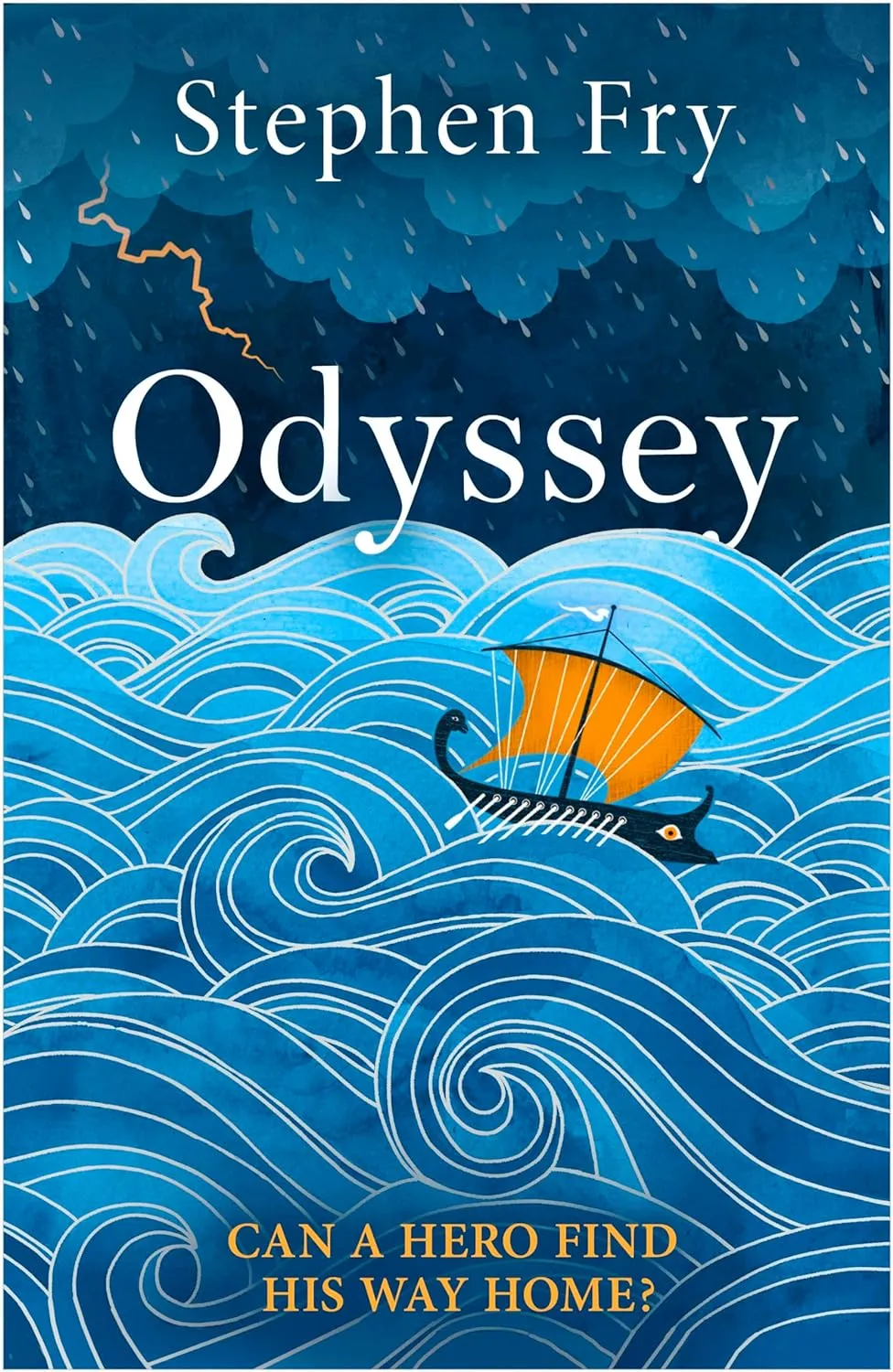
Stephen Fry - Odyssey
The fleet of Achaeans, Danaans, Hellenes, Argives – easier to call them ‘Greeks’, although there was no such country as Greece then
Page: 6, Location: 381-382
The fleet of Achaeans, Danaans, Hellenes, Argives – easier to call them ‘Greeks’, although there was no such country as Greece then – sailed east to Troy, to which they laid siege for ten brutal, bloody years.
Page: 6, Location: 381-383
Aphrodite naturally sided with Troy, as did her lover the war god Ares and the archer god twins Artemis and Apollo. Having been as they saw it spurned by Paris, Athena and Hera took up the cause of the Greeks. Zeus, distressed by the whole affair, attempted some kind of neutrality.
Page: 6, Location: 383-386
The war was over. For the Trojans, home was destroyed. For the Greeks, home beckoned.
Page: 7, Location: 392-393
It was unreasonable of her; it was childish of her; but she blamed them for arriving at the very point to which she had led them. Happily, she found – as we all contrive to find – a fitter target for her anger than herself.
Page: 12, Location: 416-417
Of all the Greeks Athena favoured, she loved none more than ODYSSEUS of Ithaca.
Page: 13, Location: 426-427
He offered her the gift of prophecy, which she gratefully accepted. When he moved forward to exact what he considered a just reward for this gift, she repelled him, shocked that he could imagine he had earned the right to her body. In his turn stung and humiliated, Apollo could not take back his gift – no god can – but he could blight it. He spat in her mouth. Thenceforward, no one would ever believe her prophecies, eternally accurate as they would always
Page: 14, Location: 439-442
Odysseus, mastermind of the stratagem that finally won the war, had been awarded the great prize of Troy’s queen, Hecuba.
Page: 16, Location: 459-460
perfunctory
Page: 18, Location: 477-477
Myrmidon
Page: 18, Location: 482-482
The cosmic laws of Time, Fate, Necessity, Justice and Retribution were inescapable and unstoppable.fn9
Page: 19, Location: 495-496
Time, Fate, Necessity, Justice and Retribution. Before these implacable executors of the deep will of the cosmos, all Titans, gods, men, women and worlds were as fluff and chaff in the wind.
Page: 20, Location: 501-503
These powers had no face or figure, no personality, presence or place that could be prayed to or placated. But there came certain times when the signs of their working could be most clearly felt. This, now, Athena felt sure, was such a time.
Page: 20, Location: 503-504
Yet somehow Agamemnon always felt that the awe, wonder and worship accorded to Achilles, Odysseus, Diomedes, Ajax, Patroclus, Nestor and Teucer had never quite been accorded him.
Page: 23, Location: 537-539
nonpareil.
Page: 24, Location: 540-540
As for the gods! Every single one of those heroes had been aided by an Olympian during the course of the war – every single one except Agamemnon.
Page: 24, Location: 542-543
guile
Page: 28, Location: 593-593
It is always, somewhere deep down, by consent that rulers rule. Grudging approval, silent acquiescence, conditional agreement.
Page: 28, Location: 595-597
The four servants to which she referred were Boreas, Notus, Eurus and Zephyrus – the winds of the North, South, East and West.
Page: 36, Location: 680-682
But the death of Aeneas would ensure the future of her favourite human settlement, the city of Carthage.fn21
Page: 37, Location: 691-693
ARTEMIS had Ephesus, Athena her Athens, Zeus his Olympia, Aphrodite her Cyprus. Hera would outdo them all with her Carthage. The Punic Empire would rule the world and her name would be glorified with
Page: 38, Location: 697-698
tempest,
Page: 41, Location: 724-724
For example, the Greeks venerated the goddess they called Athena more highly than the Romans their version, MINERVA, who – despite being a goddess of the arts of war – meant less to them than MARS, their adaptation of Ares. Mars represented the more virile, violent and merciless aspects of combat, which suited the militaristic Romans.
Page: 45, Location: 742-745
In the more popular tellings of the origins of Rome itself, Mars fathered the city’s founding twins, Romulus and Remus, and can therefore be considered Rome’s divine patriarch. The Romans truly were a martial people.
Page: 46, Location: 748-750
‘We have a destiny, my friends, a promised land. The kingdom of Latium.fn7
Page: 48, Location: 778-779
But the final victory, after all their humiliation,
Page: 50, Location: 802-802
But the final victory, after all their humiliation, will be for the great Teucrian race.fn10 Even you, mighty Jupiter, cannot alter that future. All I demand is that you do not try to frustrate it. Let my Aeneas be. Juno’s jealousy cannot be allowed to wreck the rightful destiny of the human world.’ ‘I don’t think it’s fair to call it jealousy …’ A rumbling in the sky accompanied these words. Jupiter was determined to be allowed to finish a sentence. ‘While it is true that my dear wife and queen, Juno, did have … er, issues with Paris and the Trojans, there is also to be considered her patronage of Tyrian Carthage and her deep fondness for its people.fn11 Oracles have foretold its
Page: 50, Location: 802-809
But the final victory, after all their humiliation, will be for the great Teucrian race.fn10 Even you, mighty Jupiter, cannot alter that future. All I demand is that you do not try to frustrate it. Let my Aeneas be. Juno’s jealousy cannot be allowed to wreck the rightful destiny of the human world.’
Page: 50, Location: 802-805
sumptuous dinner. In return, Aeneas entranced
Page: 53, Location: 829-829
The Hesperian lands, washed by the waters of the Tiber, that take the name of Italus – that is where you must
Page: 54, Location: 840-840
‘Your destiny lies to the west. The Hesperian lands, washed by the waters of the Tiber, that take the name of Italus – that is where you must go.fn14
Page: 54, Location: 839-841
countenance
Page: 55, Location: 849-849
Venus smiled assent but was not fooled for a moment. ‘Anything to prevent my Aeneas from founding a great city in Italy, a city that it is foretold will one day destroy your beloved Carthage.’
Page: 55, Location: 852-853
Few if any heroes in all Greek or Roman mythology were quite as loyal and well behaved as Aeneas. But the piety that defined him meant that any loyalty to his people was always capped by his rigid obedience to divine will.
Page: 56, Location: 865-866
‘No! We are children of PROMETHEUS, and we have our own fire and will.’ With those words, which meant so much more than Aeneas could have guessed, she swept away.
Page: 57, Location: 876-877
In her final burning agony, she cursed Aeneas and his line, proclaiming eternal enmity between Carthage and the civilization that Aeneas so piously claimed it was his destiny to build: his Latium, his Italy – his Rome.
Page: 58, Location: 881-883
From one stem sprouted the brothers THYESTES and Atreus, who hated each other. Aegisthus was a son of Thyestes.fn1 Agamemnon and Menelaus were sons of Atreus. The cousins inherited the hatred and were locked in an implacable blood feud, violent and savage even by the standards of the day.
Page: 62, Location: 898-901
But – a surprising lapse this – Agamemnon and Menelaus had allowed their cousin Aegisthus (the Goatboy, as they liked to call him) to live. Which is to say Aegisthus had escaped Mycenae and lurked in the shadows, biding his time. That time came ten
Page: 63, Location: 906-908
But – a surprising lapse this – Agamemnon and Menelaus had allowed their cousin Aegisthus (the Goatboy, as they liked to call him) to live. Which is to say Aegisthus had escaped Mycenae and lurked in the shadows, biding his time.
Page: 63, Location: 906-908
This deceit in his name kindled the first sparks of what would later flare into the almighty row between him and Agamemnon, the feud that almost lost the war.
Page: 64, Location: 917-918
themselves snubbed, bullied, abused and cast into the kitchens. Only Orestes’ nurse, ARSINOË,
Page: 65, Location: 927-929
Under this new regime at the palace, Clytemnestra’s three remaining children by Agamemnon – Electra, Orestes and Chrysothemis – found themselves snubbed, bullied, abused and cast into the kitchens. Only Orestes’ nurse, ARSINOË,fn3 and her husband MENANDER, the children’s tutor, were devoted enough to feed, educate and love them.
Page: 64, Location: 926-930
The Latinized name for the genus of great albatrosses is Diomedea.
Page: 410, Location: 5391-5391
occlude
Page: 95, Location: 1225-1225
Neptune’s largest moon is Proteus. Its largest impact crater has been given the name … Pharos. Astronomers know their Greek myths.
Page: 410, Location: 5404-5405
contrapposto,
Page: 116, Location: 1421-1421
More than that – you know there is no greater oath an immortal can make than this – I swear by the cold, black waters of the River Styx itself that I wish you nothing but what you wish yourself. See me swear it. Feel it come from my deepest heart. Odysseus, trust me.’
Page: 120, Location: 1471-1474
Pylades and Orestes were extraordinarily in love, to the amusement of Strophius and Anaxibia, who likened them to Patroclus and Achilles.fn3 Such close companionships were common and blessed by the gods. The time would come when each would have to think about marriage and children; but, for the moment, their passionate fondness each for the other was a source of delight and envy all around the kingdom.
Page: 135, Location: 1593-1597
the clan of Tantalus was triple-cursed. Tantalus himself is eternally tormented in the underworld;fn4 his descendants Pelops, Atreus and Agamemnon were all victims (and perpetrators) of nameless atrocities, curse piling upon curse like Pelion on Ossa.fn5
Page: 136, Location: 1602-1605
The word ‘sycophant’ literally means ‘one who shows figs’.
Page: 410, Location: 5460-5460
expiate
Page: 140, Location: 1653-1653
Areopagus,
Page: 153, Location: 1790-1790
Its fame shall spread across the world, teaching how citizens, not kings or gods, may sit in fair
Page: 161, Location: 1877-1878
May this court be instituted to sit here, in this very spot in Athens, from this moment on and for countless generations. Its fame shall spread across the world, teaching how citizens, not kings or gods, may sit in fair judgement of each other. When that judgement is equal and undecided then, as in this case, may the final vote always fall in favour of mercy and acquittal.’
Page: 161, Location: 1876-1879
Become forces of magnanimity, not revenge. I call you to that higher purpose and rename you. Here, below the Seat of Ares, will be the shrine of the Eumenides, the Kindly Ones.’
Page: 162, Location: 1884-1886
incredulity.
Page: 174, Location: 1980-1981
supplication.
Page: 185, Location: 2061-2061
Queen Arete looks at Nausicaa’s flushed face and averted gaze and smiles. She remembers the old saying, ‘It is easier to conceal an elephant under your arm than to hide the look of love in your
Page: 189, Location: 2103-2104
Queen Arete looks at Nausicaa’s flushed face and averted gaze and smiles. She remembers the old saying, ‘It is easier to conceal an elephant under your arm than to hide the look of love in your eye.’
Page: 189, Location: 2103-2104
‘If I tell you how it really was, you will be able to sing the truth to the next guests fortunate enough to gather under this roof and enjoy your famous Phaeacian hospitality. But don’t sing of heroes. There are no heroes in this tale. Only men and women. And gods … always gods.’
Page: 192, Location: 2140-2143
I was pumped with such pride, and with such fury at the horrible deaths of six good men, that the combined persuasive powers of my wife Penelope and my mother Anticlea could not have deterred me.
Page: 210, Location: 2332-2334
recrimination
Page: 223, Location: 2435-2435
tried to hug her, but she was a cloud, a form without substance, and her wraith slipped through my arms.
Page: 243, Location: 2650-2650
danger for them all.’ I tried to hug her, but she was a cloud, a form without substance, and her wraith slipped through my arms.
Page: 243, Location: 2649-2650
I tried to hug her, but she was a cloud, a form without substance, and her wraith slipped through my arms.
Page: 243, Location: 2650-2650
beguiling
Page: 250, Location: 2726-2726
foreboding.
Page: 258, Location: 2815-2815
depredations
Page: 288, Location: 3105-3105
Odysseus made to follow, but as he neared the gate himself, he heard a strange whining noise. On a pile of old bones, dung and litter, an ancient and emaciated dog lay panting, its grizzled fur ravaged by mange and ticks. It strained up towards Odysseus, flattened its ears and gave a feeble wag of the tail. It was all Odysseus could do not to cry out. He knew Argus at once. His favourite hound. He had last seen him, barely out of puppyhood, howling woefully on the quayside twenty years ago when his master departed for Troy. That had been Odysseus’s last image of home as his ship left harbour. Telemachus in his mother’s arms, Argus leaping and yowling, Penelope trying not to weep.
Page: 300, Location: 3234-3239
Odysseus dropped his hand to stroke him. Argus lifted his head and whimpered with joy. His twenty-year wait was over. He and his master were reunited. A shiver ran through him. He gave a low growl and died.
Page: 300, Location: 3239-3241
malodorous
Page: 318, Location: 3437-3437
alive,’ scoffed Antinous, ‘the old fool is blubbing.
Page: 322, Location: 3483-3484
Telemachus means ‘warrior far away’, and Telegonus means ‘born far away’.fn2 Odysseus was nothing if not a remote father.
Page: 346, Location: 3822-3824
Trying to present the Odyssey as a story of a faithful, loving husband yearning for his beloved wife is all very well, but given his propensity to father children by women beginning with ‘C’ alone – Circe, Calypso and now Callidice (which perhaps ironically means ‘good judgement’) – we have to appraise Odysseus against standards of marital fidelity and monogamy rather different from our own.
Page: 347, Location: 3829-3832
Telegonus takes the body of Odysseus, along with Penelope and Telemachus, to his mother’s island and the place of his birth, Aeaea. They bury Odysseus.fn3 Circe makes them all immortal. Telegonus marries Penelope, and Telemachus marries Circe. Thus the mature women acquire fresh young sons of Odysseus to replace the original, and therefore, I suppose, they might be considered the winners.
Page: 348, Location: 3842-3846
Perhaps Odysseus didn’t ‘long to be’ on Aeaea, but Circe certainly longed for him to be there. Immortals usually get their
Page: 349, Location: 3854-3855
Perhaps Odysseus didn’t ‘long to be’ on Aeaea, but Circe certainly longed for him to be there. Immortals usually get their way.
Page: 349, Location: 3854-3855
coup de grâce.
Page: 350, Location: 3866-3866
The ultimate victory of Troy over Greece through the foundation of Rome by the Trojan Aeneas is repeatedly referred to by Virgil throughout his epic as a victory of Asia over the western Mediterranean. One of the epithets used for Aeneas is ‘descendant of Dardanus’ – from whom come the Dardanelles. The Trojan peninsula was then as now a gateway between continents. From the Trojan War through the schism that moved the Roman Empire to Byzantium, the Crusades, the wars between Europe and the Ottoman Empire – paused if not concluded by the Great War – the area has always been an ethnical and geographical flashpoint.
Page: 350, Location: 3866-3871
As an interesting sidebar, there grew up a legend, largely disseminated by the twelfth-century historian and cleric Geoffrey of Monmouth, that a descendant of Aeneas called Brutus went to a damp, foggy island somewhere north of France, defeated a race of giants there and settled his own realm, which was named, after a slight corruption of Brutus, ‘Britain’. Rule Brutannia
Page: 351, Location: 3878-3881
noosphere
Page: 354, Location: 3909-3909
If a Prometheus amongst us were to give AI consciousness, the divine spark, then humanity could become a mythic memory, an origin story for the machines to tell themselves, while we crumble into broken statuary alongside Zeus and his pantheon before us.
Page: 354, Location: 3914-3916
philhellenes
Page: 355, Location: 3922-3922
desuetude
Page: 356, Location: 3930-3930
But that is perhaps the greatest of all Greek tricks – idealism, the imagining of perfect Platonic forms and paradigms that can be posited and, once posited, pursued. ‘Let us go back to the perfect age of the perfect Areopagus’ skips the unfortunate truth that there never was such an age nor such an institution.
Page: 356, Location: 3933-3935
The ancient Greeks had a word for the hero’s journey home, their voyage of peril, temptation, loss, yearning and epic adventure. The word was nostos. Thousands of years later, it was to be combined with the Greek for ‘longing’, ‘sorrow’ and ‘pain’, algia, to form the new word nostalgia, coined in 1688 by a Swiss academic to describe the acute homesickness suffered by Swiss mercenary soldiers pining – not quite for the fjords – but for the peaks and valleys of their native Alps. Slowly ‘nostalgia’ evolved to extend its meaning to a longing for a time as much as a place.
Page: 359, Location: 3951-3955
hierophants
Page: 366, Location: 4036-4036
What the German philosopher Karl Jaspers called ‘the Axial Age’ saw the founders of Confucianism, Taoism, Jainism, Buddhism and Zoroastrianism (Confucius, Lao-Tse, Mahavira, Siddhartha and Zarathustra) all living at the same time, alongside Old Testament Prophets such as Elijah, Jeremiah and Isaiah. Greek thinkers like Heraclitus, Pythagoras and Anaxagoras breathed the same air too.
Page: 366, Location: 4038-4040